Cats · Beds & Comfort
Cave Bed vs Open Cat Bed: Which Fits Your Cat’s Resting Style?
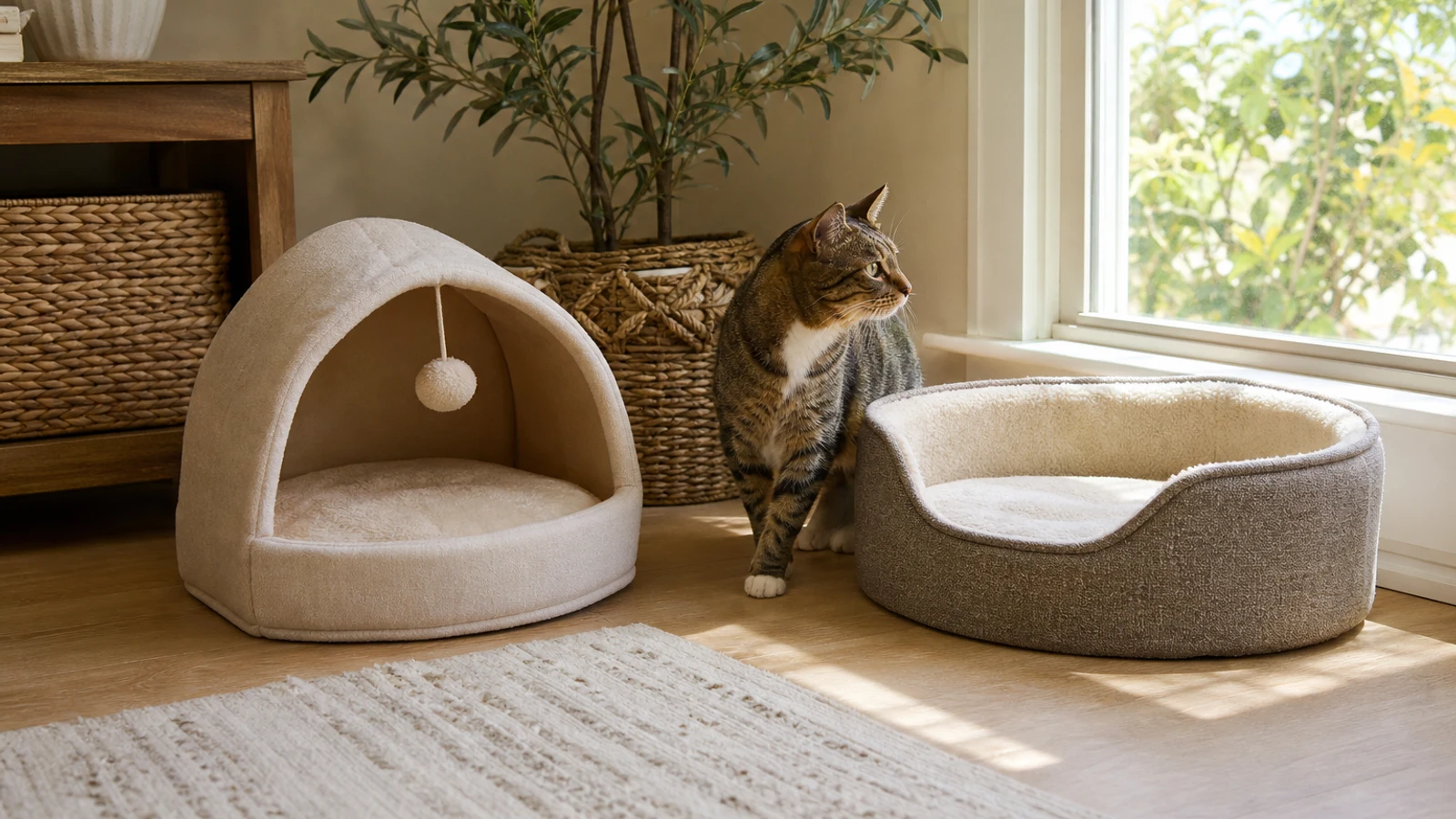
A cave bed suits cats that seek privacy, warmth, or a sheltered retreat. An open bed is usually better for cats that like to watch the room, stretch out, or need easier access. The best choice depends on where and how your cat already sleeps.
Quick answer
Choose a cave bed if your cat regularly sleeps in boxes, under furniture, closets, or other sheltered spaces, or if the household needs a quieter retreat from people and other pets. Choose an open bed if your cat prefers sofas, windowsills, elevated perches, or visible sleeping spots and likes to stretch or monitor activity. If you are unsure, offer both styles—or start with a flexible bed that can be used open and partially covered.
Shop this guide
Current Amazon options
Six current listings related to this buying decision. Use the guide to compare fit and trade-offs, then verify the latest seller, price, size, and availability on Amazon.
As an Amazon Associate I earn from qualifying purchases. Product availability, seller, price, and listing details can change.
Key decision checks
The practical difference: privacy versus visibility
A cave bed gives your cat a partially enclosed place to withdraw, conserve body heat, and rest with fewer visual distractions. It is most useful for cats that already choose boxes, closets, space under furniture, or other snug locations. A cave can also give a timid cat a dedicated retreat, but it should remain easy to enter and leave without being disturbed.
An open cat bed prioritizes visibility and access. It suits cats that sleep on sofas, blankets, window perches, cat trees, or other places where they can watch the household while resting. Open designs also make it easier for a cat to stretch, change position, and respond quickly to activity around the room. Neither shape is universally better; the cat’s established sleeping pattern is the strongest starting point.
- Cave bed: more privacy, shelter, and warmth; less visibility and sometimes less usable space.
- Open bed: easier access, better airflow and visibility, and more room for sprawling.
- Bolster or high-sided open beds can provide some security without fully enclosing the cat.
Choose a cave bed for a cat that seeks shelter
A cave bed is the closer match when your cat routinely chooses enclosed or partly covered resting places. Cats often use sheltered spaces to feel protected and maintain control over interactions, especially in homes with visitors, children, dogs, or cats that do not rest comfortably together. A safe place should be located where the cat can retreat without being cornered or repeatedly pulled out.
Look for a cave with a stable opening, enough interior room for the cat to turn around and change position, and an entrance that does not collapse over the face. A cave placed in a quiet corner can work well, but avoid treating it as a way to confine the cat. The cat should be able to leave freely, and another pet or child should not be able to block the entrance.
- Good match for cats that sleep in boxes, under beds, behind furniture, or in closets.
- Useful when a cat needs a predictable retreat from household traffic or other pets.
- Check both the entrance size and the usable sleeping area; exterior dimensions can be misleading.
- Avoid placing a single-entry cave in a dead-end location where another animal could block access.
Choose an open bed for a cat that watches and sprawls
An open bed is usually the better fit for cats that rest in visible locations or prefer to keep track of household activity. Some cats relax most when they can see approaching people, hear familiar sounds, and leave immediately. An open bed also works well for cats that sleep stretched out, switch positions frequently, or dislike pushing through a small entrance.
Open beds are especially practical on a sofa, shelf, cat tree, or window-adjacent resting area when the surface is stable and the bed cannot slide. A non-skid base can matter more than extra padding. If your cat prefers height, a low open bed on a secure elevated platform may be more appealing than a floor-level cave, but the setup must be appropriate for the cat’s mobility and the furniture’s stability.
- Good match for cats that sleep on couches, beds, windowsills, or elevated perches.
- Better for sprawling cats or cats that dislike enclosed entrances.
- A raised rim can provide head support and a sense of boundaries without blocking the view.
- Use a stable, non-slip location, especially on furniture or elevated surfaces.
Household conditions can decide the style
The cat’s personality is important, but the surrounding household can change which design is practical. In a busy home, a cave may offer needed privacy. In a multi-cat home, however, a single cave with one opening can become a poor choice if another cat guards the route. Provide separate resting and retreat options in different areas so each cat can choose where to sleep without competing for access.
Temperature and traffic also matter. A cave may feel warmer and more sheltered in a cool, drafty room, while an open bed may be preferable in a warm or sunny location where airflow and easy repositioning are useful. Do not use a bed to solve persistent fear, conflict, or hiding; those problems may need changes to the environment and professional guidance.
- For multiple cats, provide separate resting choices rather than expecting cats to share one bed.
- Keep beds away from litter boxes, loud appliances, heavy foot traffic, and places where a dog or child can interrupt rest.
- In warm rooms, prioritize airflow, shade, and the cat’s ability to leave the bed easily.
- For older or less mobile cats, choose a low-entry design and avoid forcing jumps to reach a favorite resting place.
Compare options for your pet
Cave Bed vs Open Cat Bed: Which Fits Your Cat’s Resting Style?
Compare current Amazon listings using the fit and safety checks in this guide. Confirm size, specifications, seller and availability before ordering.
See on Amazon →As an Amazon Associate I earn from qualifying purchases. Links open Amazon search results; individual listings have not been independently verified.
Size, access, and construction matter more than appearance
Measure the space your cat actually uses, not only the bed’s outside dimensions. A cave should let the cat enter, turn around, curl up, and adjust position without pressing against the roof. An open bed should allow the cat to lie in its preferred posture without hanging over the edge. Cats that alternate between curling and full-length stretching may need a larger open bed or two different resting options.
Inspect the design before buying. The bed should sit flat, keep its shape under normal use, and have no exposed loose fibers, unstable supports, or easily detached parts that could become a problem. For elevated beds, follow the manufacturer’s mounting and weight guidance. A soft bed is not automatically suitable if it slides, collapses, or leaves the cat unable to exit comfortably.
- Compare interior sleeping dimensions, not only length, width, or a suggested weight range.
- For caves, check the opening diameter or height and whether the roof stays clear of the cat’s face.
- For open beds, check the usable floor area and whether the rim reduces the sleeping space.
- Choose materials that remain stable and comfortable after washing according to the care instructions.
Cleaning and acceptance: the overlooked trade-off
Open beds are generally easier to inspect, vacuum, and clean because fur, litter, and moisture are visible. Cave beds can collect more hair and debris inside the enclosed area, particularly when the lining or cushion cannot be removed. Before buying, confirm whether the cover, cushion, or entire bed can be washed and how it must be dried. A bed that is difficult to clean may be used less often or become impractical in a shedding household.
Cats may ignore a new bed because of its location, smell, texture, or shape rather than because they dislike beds. Place it near an established sleeping spot, add a familiar washable blanket if appropriate, and let the cat investigate voluntarily. Do not push, carry, or shut the cat inside. If a cave is rejected, leaving it open or folding the cover back can make it function more like a nest bed while the cat becomes familiar with it.
- Prefer removable, washable sleeping surfaces when possible.
- Avoid strong fragrances and wash new bedding according to its care label before use.
- Place the bed where the cat already chooses to rest instead of expecting a hidden or inconvenient location to win.
- If the cat repeatedly avoids the bed, change the location or style rather than forcing use.
When a bed preference may signal a health or stress change
A normal preference for a cave or open bed is not a diagnosis. What matters is a marked change from the cat’s usual resting pattern, especially if the cat begins hiding continuously, stops using familiar areas, seems reluctant to move, or shows changes in appetite, elimination, grooming, breathing, or social behavior. Cats can conceal discomfort, so a new bed preference should be considered alongside the rest of the cat’s behavior.
Contact a veterinarian if hiding or withdrawal is sudden, persistent, or accompanied by other physical or behavioral changes. If the concern involves fear, household conflict, or chronic stress rather than a suspected medical problem, a veterinarian can help determine whether a veterinary behaviorist or another qualified feline professional is appropriate. Product choice can support comfort, but it should not replace assessment of an underlying problem.
- A cave can provide a safe retreat, but it should not be used to hide a cat from needed care.
- Do not pull a frightened cat from its bed unless immediate safety requires it.
- Seek veterinary advice for sudden hiding, reduced appetite, pain-like behavior, breathing changes, or altered elimination.
- In multi-pet homes, address blocking, chasing, and resource conflict separately from the bed purchase.
Common questions
FAQ
Can I buy a cave bed if my cat has never used one?
Yes, but do not assume the cat will accept it immediately. Place it near a familiar sleeping area, keep the entrance clear, and allow voluntary exploration. A cave with a removable cover or a fold-down top can be introduced first as an open or high-sided bed.
Is an open bed safer than a cave bed?
Neither style is automatically safer. The important factors are stable construction, a clear exit, appropriate size, good airflow, a location that cannot be blocked, and the cat’s ability to enter and leave comfortably. Avoid designs with collapsing openings, exposed loose material, or unstable elevated mounting.
Should a shy cat always have a covered bed?
A covered bed may help provide privacy, but it is only one part of a suitable environment. The cat should also have access to separate resources, predictable interactions, and safe places that are not controlled by another pet. Persistent or worsening hiding warrants veterinary advice rather than simply adding more enclosed beds.
How many cat beds does one cat need?
There is no universal required number. One cat may use several resting locations and ignore a purchased bed. Offer choices in places the cat already values, such as a quiet floor area, a secure elevated spot, or a room where the household spends time. In multi-cat homes, provide separate retreat and resting options so cats do not have to compete.
What is the best compromise between a cave and an open bed?
A high-sided nest bed, a cave with a removable roof, or a bed with a fold-back cover can offer privacy without fully enclosing the cat. This is useful when you are still learning the cat’s preference or when the cat alternates between curling up and watching the room.
Sources & further reading
Where the factual guidance comes from
Ready to choose?
Cave Bed vs Open Cat Bed: Which Fits Your Cat’s Resting Style?
Compare current Amazon listings using the fit and safety checks in this guide. Confirm size, specifications, seller and availability before ordering.
See on Amazon →As an Amazon Associate I earn from qualifying purchases. Links open Amazon search results; individual listings have not been independently verified.
Keep researching