Cats · Home & Safety
Suction-Cup vs Sill-Mounted Cat Window Perch: Which Is Easier to Trust?
Suction-cup perches are easier to install and remove, but they depend on clean, smooth glass and ongoing inspection. Sill-mounted models can feel more predictable when the sill and brackets fit correctly, but they need a suitable window ledge and may require adhesive or hardware. The easier perch to trust is the one that matches your window, cat, and willingness to perform regular checks.
Quick answer
Choose a suction-cup perch when you rent, need a no-drill setup, or want to position the resting platform directly on the glass. Choose a sill-mounted perch when you have a strong, compatible sill and prefer a setup that does not rely on suction seals. Neither design should be treated as automatically safe: verify the manufacturer’s weight limit, install exactly as directed, keep the window closed or securely screened, and inspect the mount before your cat uses it.
Shop this guide
Current Amazon options
Six current listings related to this buying decision. Use the guide to compare fit and trade-offs, then verify the latest seller, price, size, and availability on Amazon.
As an Amazon Associate I earn from qualifying purchases. Product availability, seller, price, and listing details can change.
Key decision checks
The practical difference: glass grip versus sill support
A suction-cup perch transfers your cat’s weight through cups pressed against a smooth glass pane. It usually installs without drilling, can fit windows with little or no usable ledge, and is easy to remove when you move or need to clean the glass. Its reliability depends on the seal at every cup, the condition of the cups, the cleanliness of the glass, and the stability of the window itself.
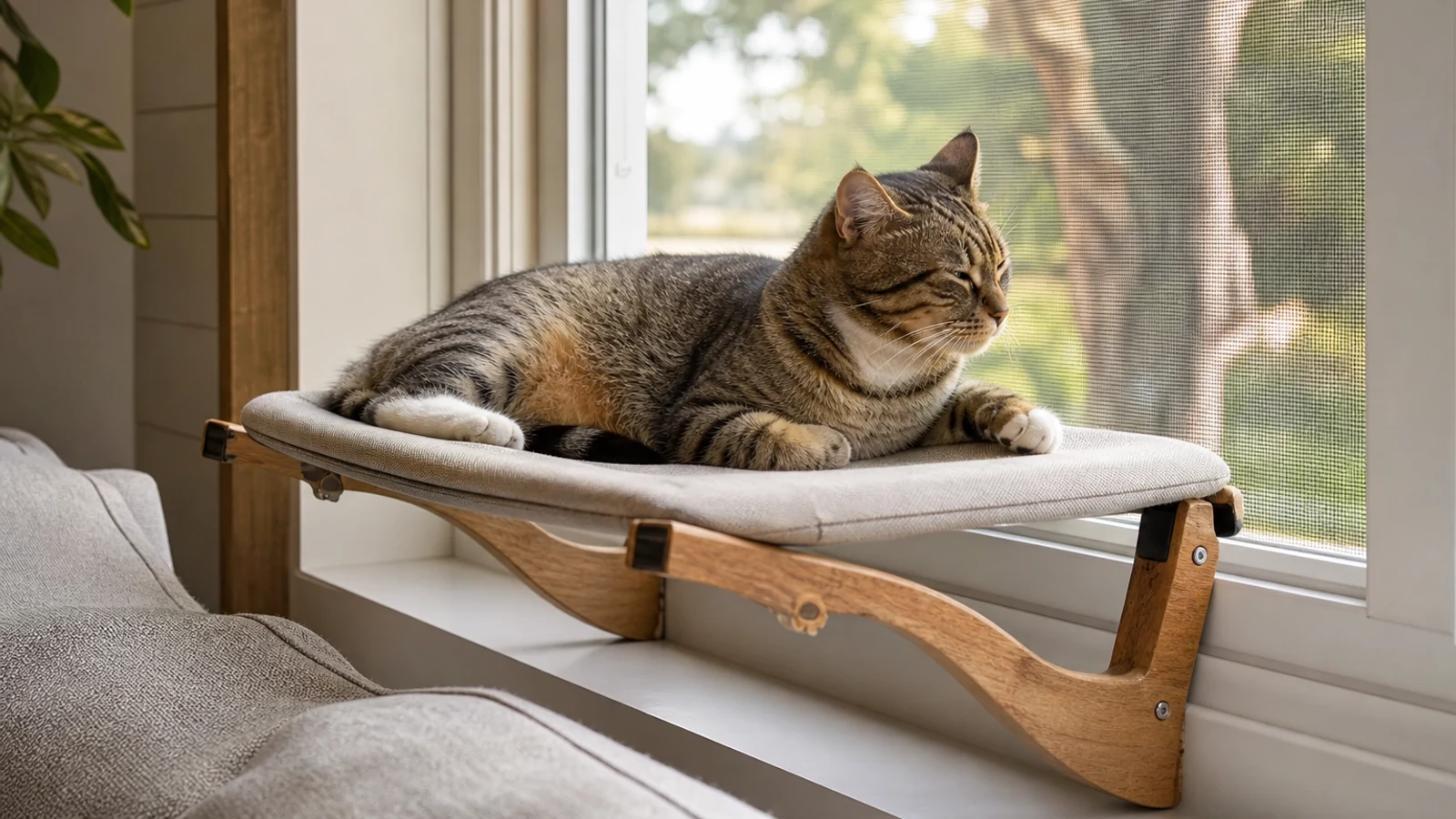
A sill-mounted perch rests on, clamps to, or brackets against the windowsill. That shifts the main question from “Will the cups stay sealed?” to “Is this sill strong, deep, level, and compatible with the supplied supports?” A well-fitting sill model may be easier to monitor because its support points are visible, but a poor fit can rock, slide, interfere with the window, or place force on a fragile ledge.
- Suction-cup advantage: no drilling, minimal floor space, and flexible placement on a suitable glass pane.
- Sill-mounted advantage: no suction seal to maintain and often a more grounded feel when the sill and brackets fit correctly.
- Neither option is a substitute for a secure window screen or a closed window when a fall or escape is possible.
When a suction-cup perch makes more sense
Start with the window, not the product listing. Suction cups generally need a clean, dry, smooth, flat glass surface; textured, frosted, heavily coated, dirty, or irregular panes may not provide a dependable seal. You also need enough unobstructed glass for every cup and enough clearance for the frame, straps, supports, blinds, and window hardware.
This style is especially useful in apartments, dorm rooms, or homes where drilling and permanent changes are not allowed. It can also solve a layout problem when the sill is narrow, crowded, unusually shaped, or absent. The trade-off is continuing attention: suction cups can weaken with wear, debris, temperature changes, sunlight, or repeated use, so installation is not a one-time task.
- Confirm the product’s approved surface and minimum glass dimensions before ordering.
- Clean and dry both the pane and cups according to the instructions; avoid assuming a cup that feels attached is fully sealed.
- Check every cup, connector, strap, and frame before use, and replace damaged or hardened parts.
- Position the perch where a possible drop would not land on a sharp edge, hard corner, or fragile object.
When a sill-mounted perch makes more sense
A sill-mounted model is usually the better fit when your window has a sturdy, sufficiently deep ledge and you want to avoid relying on suction-cup adhesion. Some models use brackets, clamps, fastening strips, or screws, so the installation method matters. Adhesive-based systems may require a clean surface and a setting period before use; bracketed systems may require careful leveling and enough room beneath the sill.
This approach is not automatically stronger. A decorative, damaged, very shallow, sloped, or hollow sill may be unsuitable. The perch must not prevent the window from closing and latching, obstruct blinds in a way that creates tension, or shift when your cat jumps on or off. If the instructions call for screws or permanent hardware, confirm that the wall, frame, or sill can accept them safely before proceeding.
- Measure sill depth, width, height, and the distance to the wall or window frame.
- Check whether the supplied brackets sit flat and remain level without forcing the sill or trim.
- Follow any adhesive curing time exactly; do not shorten it because the perch feels attached.
- Test the mounted perch by applying controlled pressure before allowing your cat to climb onto it.
Which design is easier to trust day to day?
For a compatible window, a sill-mounted perch is often easier to trust if you prefer a visible support structure and fewer recurring seal checks. That judgment only applies when the sill is strong and the hardware is correctly fitted. A badly matched sill perch can be less dependable than a properly installed suction model because rocking, slipping, or uneven support may go unnoticed until the cat jumps onto it.
A suction-cup perch is easier to trust when portability, reversibility, and no-drill installation matter most and you are willing to inspect it routinely. Use the maker’s stated weight limit as a ceiling, not a target, and account for more than the cat’s resting weight: jumping, climbing, sudden movement, and multiple cats can create greater forces than a static load.
- For a renter with smooth glass and a cat who settles calmly: suction-cup may be the practical choice.
- For a homeowner with a broad, solid sill and a heavier or highly active cat: a properly fitted sill-mounted model may be more reassuring.
- For two cats, frequent jumping, or an uncertain window structure: consider a fixed wall or floor-based cat tree instead of relying on a window mount.
- If the perch shifts, sags, cracks, detaches, or produces new noises, remove it from service until the cause is resolved.
Compare options for your pet
Suction-Cup vs Sill-Mounted Cat Window Perch: Which Is Easier to Trust?
Compare current Amazon listings using the fit and safety checks in this guide. Confirm size, specifications, seller and availability before ordering.
See on Amazon →As an Amazon Associate I earn from qualifying purchases. Links open Amazon search results; individual listings have not been independently verified.
Window safety matters more than the perch style
A window perch should provide indoor enrichment, not encourage access to an unsafe opening. Animal-welfare and veterinary guidance consistently warns that cats can fall through open windows or push against weak screens. A perch placed beside an open window can give a cat more leverage and height, so keep the window closed unless it has a snug, sturdy, cat-appropriate screen or another professionally appropriate barrier.
Do not assume a standard insect screen will withstand a determined cat, a chase response, or a startled jump. Window guards designed for children may leave openings that are not suitable for cats. If your cat has fallen, struck a screen, escaped through a window, or shows unusual weakness, breathing difficulty, pain, or reluctance to move, contact a veterinarian promptly; a fall can cause injuries that are not obvious immediately.
- Keep the window closed when the cat is unsupervised unless the opening is securely protected.
- Check screen frames, latches, clips, and mesh—not just whether the screen appears to be in place.
- Keep blind cords, curtain loops, heaters, and sharp objects away from the jumping path.
- Do not place a perch where a failed mount could shatter glass or drop onto people, pets, or hard furniture.
A buying checklist that avoids the common mismatches
Compare the installation requirements with your actual window rather than choosing by cup count, advertised load figure, or appearance. Manufacturer weight claims are product-specific and may assume a particular installation, surface, and number of supports. A model rated for a large cat is not automatically appropriate for a wide jumping cat, two cats, a damaged pane, or a window whose frame moves when opened.
Also inspect the care instructions before buying. Removable covers, washable fabrics, replaceable suction cups, accessible fasteners, and clear inspection guidance make long-term ownership easier. If replacement parts are unavailable or the instructions do not explain how to identify wear, treat that as a maintenance disadvantage.
- Cat fit: measure your cat and compare the usable sleeping area, not only the outside dimensions.
- Load fit: use the manufacturer’s limit and consider the cat’s jumping behavior and household cat count.
- Window fit: verify pane size, sill depth, frame shape, opening direction, and clearance for coverings.
- Maintenance fit: look for replaceable cups or hardware, washable covers, and straightforward inspection steps.
- Failure planning: choose a location and floor surface that reduce injury risk if the mount fails.
Bottom line: choose the setup you can verify
Suction-cup and sill-mounted perches are not competing on a single scale of “safe” and “unsafe.” They solve different installation problems. Suction cups win on reversibility and placement flexibility but require clean glass and repeated checks. Sill-mounted designs win when a strong, compatible ledge provides a stable base, but they demand accurate measurements and careful installation.
If you cannot confidently verify the glass, sill, frame, hardware, or screen, do not use that window as the test site. A stable cat tree beside a closed window can deliver the view without transferring your cat’s weight to a questionable mount. The best choice is the one whose support method matches your home and whose maintenance routine you will actually follow.
Common questions
FAQ
Are suction-cup cat window perches safe for large cats?
They can be appropriate only when the specific model, glass surface, and installation meet the manufacturer’s requirements. Check the stated weight limit, allow for jumping forces and multiple cats, inspect every cup and connector, and use a lower-risk location. If the window or perch shows any uncertainty, choose a fixed cat tree or another more stable setup.
Can I use a suction-cup perch on a window with privacy film or frosted glass?
Do not assume it will work. Suction cups generally need smooth, clean, flat glass, and surface films or texture can affect the seal. Use the manufacturer’s approved-surface guidance; if it does not clearly cover your window, contact the manufacturer or choose a sill- or floor-mounted alternative.
Do sill-mounted cat perches damage windowsills?
Some use adhesive, clamps, or screws, and each can affect the sill differently. Adhesive may leave residue or pull at paint, while excessive clamping or unsuitable screws can damage trim or a weak ledge. Test the fit and read the installation requirements before buying, especially in a rental.
How often should I check a suction-cup cat perch?
Check it before your cat uses it, after installation or repositioning, and routinely thereafter. Look for cups lifting at the edges, cracks, hardening, dirt, loose connectors, frame movement, or a change in level. Follow the product instructions for inspection and replacement; do not wait for a visible failure.
Can my cat use a window perch while the window is open?
Only if the opening is protected by a secure, cat-appropriate barrier that cannot be pushed out or bypassed. A regular insect screen may not be enough for a determined or startled cat. Keep the window closed when reliable protection is uncertain, and ask a qualified window professional or veterinarian for situation-specific safety advice.
Sources & further reading
Where the factual guidance comes from
Animal-welfare handout emphasizing correct suction-cup attachment and regular checks because seals can weaken over time.
Window-perch installation instructions covering sill preparation, adhesive setting time, bracket adjustment, and testing before pet use.
Ready to choose?
Suction-Cup vs Sill-Mounted Cat Window Perch: Which Is Easier to Trust?
Compare current Amazon listings using the fit and safety checks in this guide. Confirm size, specifications, seller and availability before ordering.
See on Amazon →As an Amazon Associate I earn from qualifying purchases. Links open Amazon search results; individual listings have not been independently verified.
Keep researching