Other Pets · Home & Safety
Metal vs Fabric Rabbit Playpen: Which Fits Indoor Use Better?
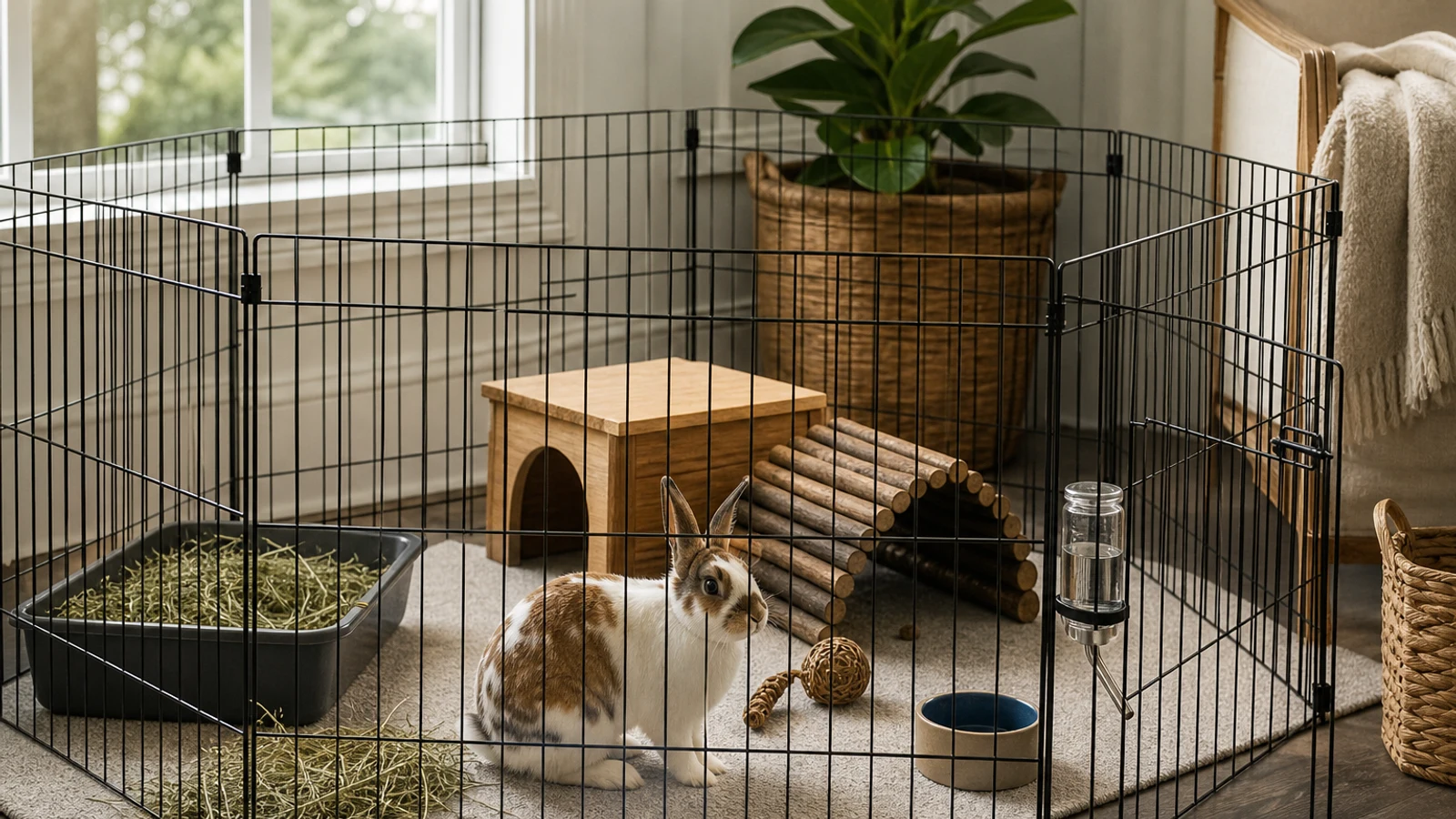
For most indoor rabbits, a sturdy metal exercise pen is the safer primary enclosure because it resists chewing, provides ventilation, and supports useful access doors and modular layouts. A fabric playpen can be convenient for supervised travel or short sessions, but it demands closer inspection for chewing, climbing, trapped limbs, and escape risk.
Quick answer
Choose a metal rabbit playpen for everyday indoor containment, especially if your rabbit chews, pushes, climbs, or spends unsupervised time in the pen. Choose fabric only when portability, quick setup, or temporary supervised use matters more than durability. Neither option replaces a properly sized living area, solid comfortable flooring, enrichment, and regular exercise outside the pen.
Shop this guide
Current Amazon options
Six current listings related to this buying decision. Use the guide to compare fit and trade-offs, then verify the latest seller, price, size, and availability on Amazon.
As an Amazon Associate I earn from qualifying purchases. Product availability, seller, price, and listing details can change.
Key decision checks
Metal is usually the better primary indoor pen
A metal exercise pen is generally the more practical choice for daily indoor rabbit use. Welded or securely joined panels provide ventilation, allow the rabbit to see out, and are less likely than fabric walls to be shredded by persistent chewing. Many designs also offer a walk-through door, adjustable layouts, and the height needed to reduce jumping escapes.
Fabric pens are more attractive when the main job is portability. They fold quickly, weigh less, and can be useful for travel, temporary separation, or closely supervised play. The trade-off is that fabric mesh, seams, zippers, and flexible frames can become escape points or chewing targets, so convenience does not automatically equal safe long-term housing.
- Best default for daily indoor containment: sturdy metal exercise pen.
- Best use for fabric: supervised, temporary, or travel situations.
- Do not select either style based on appearance alone; inspect the complete setup, including flooring and fasteners.
The rabbit’s behavior should decide the material
A calm rabbit that ignores mesh may tolerate a fabric pen during supervised sessions, but a determined chewer can damage fabric surprisingly quickly. Rabbits may also pull at zippers, seams, corner bindings, and mesh openings. If your rabbit has already chewed carpet, blankets, play mats, or cords, treat a fabric pen as a higher-risk option rather than assuming the material will be ignored.
Metal is not automatically safe. A rabbit may chew bars, push unsecured panels, or catch a foot in an unsuitable opening. Look for smooth, intact surfaces and stable connections, and remove any pen with sharp wire ends, peeling coatings, loose clips, or gaps that could trap a head, paw, or leg.
- Choose metal when your rabbit chews enclosure walls, climbs, or repeatedly tests barriers.
- Choose neither material without supervision if the rabbit can reach electrical cords, toxic plants, unsafe flooring, or other household hazards.
- Recheck the pen after rearranging panels or adding platforms, hides, bowls, or litter equipment.
Flooring matters more than the wall material
The wall can be metal or fabric, but the rabbit should not spend its time standing on a wire floor. Rabbit-care guidance warns that wire flooring can contribute to foot trauma and sore hocks. Use a solid, stable base protected by a washable surface, with enough traction that the rabbit can hop, turn, rest, and stand without sliding.
Fabric is often more useful as a removable floor covering than as a pen wall. Washable blankets, low-pile rugs, or other rabbit-appropriate coverings can make a solid base more comfortable, but they must be monitored for chewing, loose threads, dampness, and bunching. Put a waterproof barrier underneath when protecting carpet or hardwood is important.
- Use a solid floor rather than relying on wire mesh underfoot.
- Secure coverings so they do not bunch, slide, or expose hard edges.
- Replace flooring that is persistently wet, frayed, contaminated, or being swallowed.
- Keep hay, litter, water, a hide, and chew-safe enrichment arranged so the rabbit can move naturally.
Size, height, and escape resistance come first
A playpen should create a meaningful living and exercise area, not merely confine the rabbit to a small circle. Current rabbit-welfare guidance emphasizes space for hopping, exploring, resting, hiding, feeding, and enrichment, with regular exercise outside the enclosure. Measure the usable floor area after adding a litter box, hide, bowls, toys, and any ramps or platforms.
Metal panels are easier to enlarge or reshape as household needs change. Fabric pens may offer a similar footprint on paper, but their flexible walls can bow inward or allow climbing against the sides. Select a height that accounts for your rabbit’s ability to jump onto nearby objects, and avoid placing furniture beside the pen that creates an easy launch point.
- Prioritize usable floor area over a tall but narrow design.
- Allow room for a litter box, hideout, feeding area, resting area, and movement.
- Check the pen’s stability when the rabbit pushes, bounces, or jumps against it.
- Use a top or a different arrangement if the rabbit can clear the walls safely.
Compare options for your pet
Metal vs Fabric Rabbit Playpen: Which Fits Indoor Use Better?
Compare current Amazon listings using the fit and safety checks in this guide. Confirm size, specifications, seller and availability before ordering.
See on Amazon →As an Amazon Associate I earn from qualifying purchases. Links open Amazon search results; individual listings have not been independently verified.
Cleaning and household protection favor simple metal layouts
Metal panels are usually easier to wipe, inspect, and separate from the rabbit’s soiled flooring. A removable waterproof base or mat can protect the household floor while keeping the pen itself open and ventilated. Fabric walls can be machine-washable, but stains and urine may collect around seams, zippers, corners, and lower mesh panels where drying can be slower.
Whichever style you choose, cleaning is part of the safety decision. Remove wet bedding promptly, keep the litter area manageable, and inspect for odor, mold, fraying, corrosion, or residue. A pen that is difficult to dismantle or dry may become less hygienic even if its materials appear convenient at first.
- Prefer designs with accessible doors and few hard-to-clean crevices.
- Confirm that removable fabric parts can be washed and fully dried.
- Use a waterproof underlayer that extends beyond the pen footprint.
- Inspect metal for rust, rough welds, bent sections, and damaged coatings.
When fabric makes sense—and when it does not
A fabric playpen can make sense for a rabbit that is calm around mesh, does not chew enclosure materials, and will remain within sight during use. It may also be useful for a short stay in a hotel, a temporary recovery area when directed by a veterinarian, or a controlled introduction to a new space. In each case, the rabbit’s behavior and the pen’s condition should be monitored rather than assumed safe.
Fabric is a poor match for unsupervised daily housing when the rabbit chews, digs at corners, climbs, pushes panels, or becomes distressed when confined. It is also a poor fit if the lower edge can be reached from a litter area or if the fabric absorbs moisture and cannot be cleaned thoroughly. For these rabbits, a secure metal pen combined with safe flooring is usually the more defensible starting point.
- Use fabric only when the rabbit cannot readily damage or escape it.
- Keep fabric away from persistent dampness and direct access to chewing teeth.
- Stop using it if mesh tears, seams open, zippers fail, or the frame bends.
- Ask a rabbit-experienced veterinarian about confinement changes after illness, injury, or surgery.
A practical buying checklist
The best indoor pen is the one that remains secure after you add the rabbit’s actual furnishings and observe its normal behavior. Before buying, compare the pen’s footprint, height, access, cleanability, and resistance to chewing. Do not treat a playpen as a complete habitat by itself: the setup also needs suitable flooring, ventilation, enrichment, and a rabbit-proofed surrounding area.
For many households, the most flexible arrangement is a sturdy metal pen with a solid protected floor and washable fabric coverings used only where appropriate. That combination keeps the enclosure structure durable while allowing the comfort and maintenance benefits of removable textiles.
- Choose smooth, secure construction with no sharp ends or loose fasteners.
- Confirm the door is easy for an adult to use while remaining secure when closed.
- Measure the room and the full furnished footprint before ordering.
- Check that the rabbit cannot reach cords, baseboards, toxic plants, or unsafe household items.
- Plan supervised exercise outside the pen in a rabbit-proofed area.
Common questions
FAQ
Can a rabbit live in a fabric playpen overnight?
It depends on the individual rabbit and the pen, but fabric is not the safest default for unsupervised overnight containment. A rabbit that chews mesh, seams, corners, or zippers may escape or swallow damaged material. A secure metal exercise pen with solid, comfortable flooring is generally a more durable choice for routine indoor use.
Will a metal playpen hurt a rabbit’s feet?
The wall material is not the main concern; wire flooring is. Avoid making the rabbit stand on exposed wire, and provide a solid, stable surface with suitable traction. Inspect the metal panels for sharp ends, damaged coatings, and openings that could catch a foot. Seek veterinary advice for persistent redness, swelling, sores, limping, or changes in movement.
Is fabric safer than metal because it is softer?
Not necessarily. Softer walls may reduce impact in some situations, but fabric can be chewed, torn, climbed, or contaminated more easily. Metal can also be unsafe if it has sharp edges, unstable connectors, unsuitable gaps, or exposed wire flooring. Judge the complete enclosure and the rabbit’s behavior rather than assuming one material is universally safer.
What should go underneath an indoor rabbit pen?
Use a solid, stable surface that protects the household floor and can be cleaned. A washable covering can improve comfort and traction, but monitor it for chewing, loose threads, bunching, and moisture. The appropriate surface can vary with the rabbit’s habits and health; a rabbit-experienced veterinarian should advise on flooring for a rabbit with foot problems, mobility changes, or recovery needs.
Sources & further reading
Where the factual guidance comes from
Ready to choose?
Metal vs Fabric Rabbit Playpen: Which Fits Indoor Use Better?
Compare current Amazon listings using the fit and safety checks in this guide. Confirm size, specifications, seller and availability before ordering.
See on Amazon →As an Amazon Associate I earn from qualifying purchases. Links open Amazon search results; individual listings have not been independently verified.
Keep researching